
The Misdirection
It's Not About Picking a Side.

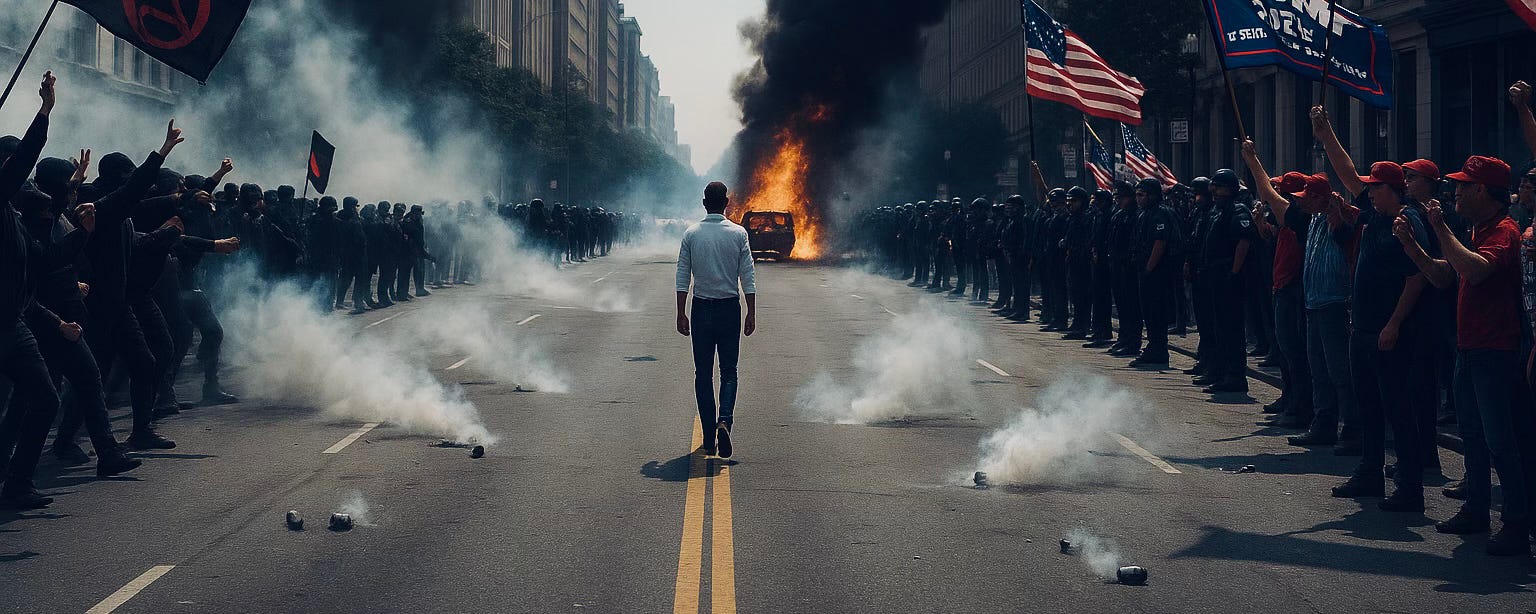
Get Out of the Framing They Gave You
Most of us, when we feel the fracture, start looking for the right side to join.
Left or right. Conservative or progressive. Traditional or modern. Pick your team, learn the talking points, find your tribe. The assumption is always the same: someone, somewhere, has figured this out. Someone has the answer.
But what if that's exactly backwards?
"We don't just believe things because they're true. We believe things because they help us belong. And in a survival-based mind, belonging always beats truth."
It's an uncomfortable recognition. That the thing driving most of our convictions isn't careful analysis or noble principle. It's the ancient, unconscious need to remain part of the group.
Because for most of human history, exile meant death. And that calculation is still running, deep in the background of every political conversation, every moral stance, every time we decide what's safe to say out loud.
"Our unconscious system was never built to weigh evidence or revise conclusions. It was built to read the room, track the vibe, keep us aligned with the tribe, and avoid exile at any cost. To disagree too strongly with the group? That wasn't just uncomfortable, it was life-threatening. So the feeling of dissonance became the feeling of danger."
Which explains why political conversations feel like warfare. Why people can look at the same evidence and reach opposite conclusions. Why intelligence doesn't seem to protect against ideological capture.
We're not debating facts. We're defending identity. Protecting belonging. Maintaining the unconscious contracts that keep us safe within our chosen tribe.
"Most of your thoughts .. especially the fast, reactive ones .. are echoes of others. And most of your beliefs were never chosen. They were installed."
Installed how? Through repetition, emotion, and trust. Through growing up in families with certain assumptions. Through education systems with particular frameworks. Through media that rewards some ideas and punishes others.
The installation happens so smoothly that we mistake the result for our own thinking. We defend beliefs we inherited as if we'd reasoned our way to them independently.
"If you grow up in a home where one political party is praised and the other demonised, your unconscious takes notes. If the adults you trust treat certain institutions with reverence, you inherit their reverence. If they laugh at certain groups and idolise others, your emotional machinery begins to lock in the patterns."
This isn't a criticism. It's how humans work. It's how we've always worked. The tribal mind isn't a bug; it's a feature. For thousands of generations, it kept us alive.
The problem is that the environment has changed faster than the software can adapt.
"When the conscious performer steps aside .. the real player is revealed, and that player cannot be bribed, coerced, or trained. It simply knows."
But underneath all the inherited programming, something else remains. Something that doesn't belong to any tribe. Something that can't be installed or updated or corrupted.
Something that recognizes truth not because it fits the narrative, but because it resonates at a frequency deeper than thought.
"You can't outvote your conditioning, out-legislate your unconscious, or out-administer your addiction to certainty. The system we see is the system we are."
Which means the real work isn't political. It's not about finding better leaders or passing better laws or winning more arguments.
It's about understanding how we became the kind of beings who create these systems in the first place. How our unconscious patterns, scaled up and networked together, generate the very problems we keep trying to solve from the outside.
"There is no they. There is only us; human beings, running unconscious pattern loops, emotionally reinforced by belonging, perceiving a version of reality designed to keep us safe."
The misdirection isn't malicious. It's just outdated.
We're still looking for tribal safety in a world that has moved beyond tribes. Still seeking simple answers to complex questions. Still trying to find the right side in a game where all the sides are symptoms of the same deeper confusion.
But once you see the misdirection, something else becomes possible.
Not picking the right side, but stepping outside the frame that makes sides seem necessary.
From "Morning Waits: Awakening to What Is Within You"